微積分用書
這是一門微積分課的中文教學,使用的書本

微積分和您之前學習的數學有根本的不同:微積分不是那麼靜態,而是更加動態。它與變化和運動有關,處理趨近其他數量的數量。因此,在開始學習微積分之前,對微積分進行概述可能會很有幫助。在這裡,我們將預覽微積分的一些主要概念,並展示它們如何建立在極限概念的基礎上。
CALCULUS IS FUNDAMENTALLY DIFFERENT from the mathematics that you have studied previously: calculus is less static and more dynamic. It is concerned with change and motion; it deals with quan- tities that approach other quantities. For that reason it may be useful to have an overview of calculus before beginning your study of the subject. Here we give a preview of some of the main ideas of calculus and show how their foundations are built upon the concept of a limit.
微積分與您之前學習的數學有根本的不同:微積分更具動態性,涉及變化和運動,處理趨近於其他數量的數量。因此,在開始學習微積分之前,了解微積分的概述可能會很有幫助。這裡,我們將預覽微積分的一些主要概念,並展示它們如何建立在極限概念的基礎上。
What Is Calculus?
The world around us is continually changing populations increase, a cup of coffee cools, a stone falls, chemicals react with one another, currency values fluctuate, and so on. We would like to be able to analyze quantities or processes that are undergoing continuous change. For example, if a stone falls 10 feet each second we could easily tell how fast it is falling at any time, but this is not what happens the stone falls faster and faster, its speed changing at each instant. In studying calculus, we will learn how to model (or describe) such instantaneously changing processes and how to find the cumulative effect of these changes. Calculus builds on what you have learned in algebra and analytic geometry but advances these ideas spectacularly. Its uses extend to nearly every field of human activity. You will encounter numerous applications of calculus throughout this book. At its core, calculus revolves around two key problems involving the graphs of functions the area problem and the tangent problemand an unexpected relationship between them. Solving these problems is useful because the area under the graph of a function and the tangent to the graph of a function have many important interpretations in a variety of contexts.
我們周圍的世界不斷變化——人口增加、一杯咖啡變涼、一塊石頭落下、化學物質相互反應、貨幣價值波動等等。我們希望能夠分析正在經歷持續變化的數量或流程。例如,如果一塊石頭每秒下落10 英尺,我們隨時都可以輕鬆判斷出它下落的速度有多快,但事實並非如此——石頭下落的速度越來越快,其速度每時每刻都在變化。在學習微積分時,我們將學習如何建模(或描述)這種瞬時變化的過程以及如何找到這些變化的累積效應。 微積分建立在您在代數和解析幾何中學到的知識的基礎上,但極大地推進了這些想法。它的用途幾乎延伸到人類活動的各個領域。在本書中你將會遇到大量微積分的應用。 從本質上講,微積分圍繞著兩個涉及函數圖的關鍵問題——面積問題和切線問題——以及它們之間意想不到的關係。解決這些問題非常有用,因為函數圖下方的面積和函數圖的切線在各種情況下都有許多重要的解釋。
The Area Problem
微積分的起源至少可以追溯到 2500 年前的古希臘人,他們使用「窮舉法」來尋找區域。他們知道如何將任何多邊形分成三角形(如圖 1 所示)並將這些三角形的面積相加來求出任何多邊形的面積 A。 求彎曲圖形的面積是一個困難得多的問題。希臘的窮舉法是在圖形中內接多邊形,並圍繞圖形外接多邊形,然後讓多邊形的邊數增加。圖 2 說明了具有內接正多邊形的圓的特殊情況的此過程。
We have seen that the concept of a limit arises in finding the area of a region and in find- ing the slope of a tangent line to a curve. It is this basic idea of a limit that sets calculus apart from other areas of mathematics. In fact, we could define calculus as the part of mathematics that deals with limits. We have mentioned that areas under curves and slopes of tangent lines to curves have many different interpretations in a variety of con- texts. Finally, we have discussed that the area and tangent problems are closely related.
- How can we design a roller coaster for a safe and smooth ride? (See the Applied Project following Section 2.3.) 我們如何設計一個安全平穩的雲霄飛車?
- How far away from an airport should a pilot start descent? (See the Applied Project following Section 2.5.) 飛行員應該在距離機場多遠的地方開始下降?
- How can we explain the fact that the angle of elevation from an observer up to the highest point in a rainbow is always 42°? (See the Applied Project following Section 3.1.) 我們如何解釋從觀察者到彩虹最高點的仰角始終為 42° 這一事實?
- How can we estimate the amount of work that was required to build the Pyramid of Khufu in ancient Egypt? (See Exercise 36 in Section 5.4.) 我們如何估算建造古埃及胡夫金字塔所需的工程量?
- With what speed must a projectile be launched so that it escapes the earth’s gravitation pull? (See Exercise 77 in Section 7.8.) 彈體必須以什麼速度發射才能逃脫地球引力?
- How can we explain the changes in the thickness of sea ice over time and why cracks in the ice tend to “heal”? (See Exercise 56 in Section 9.3.) 我們如何解釋海冰厚度隨時間的變化以及為什麼冰裂縫往往會「癒合」?
- Does a ball thrown upward take longer to reach its maximum height or to fall back down to its original height? (See the Applied Project following Section 9.5.) 向上拋出的球是否需要更長的時間才能達到最大高度或落回原始高度?
- How can we fit curves together to design shapes to represent letters on a laser printer? (See the Applied Project following Section 10.2.) 我們如何將曲線擬合在一起來設計代表雷射印表機上字母的形狀?
- How can we explain the fact that planets and satellites move in elliptical orbits? (See the Applied Project following Section 13.4.) 我們如何解釋行星和衛星沿著橢圓軌道運行的事實?
- How can we distribute water flow among turbines at a hydroelectric station so as to maximize the total energy production? (See the Applied Project following Section 14.8.) 如何在水力發電廠的渦輪機之間分配水流,以最大限度地提高總發電量?
Chapter 1 : Functions and Limits
- 1.1 四種表達函數的方法 Four Ways to Represent a Function
- 1.2 Mathematical Models: A Catalog of Essential Functions
- 1.3 New Functions from Old Functions
- 1.4 The Tangent and Velocity Problems
- 1.5 The Limit of a Function
- 1.6 Calculating Limits Using the Limit Laws
- 1.7 The Precise Definition of a Limit
- 1.8 Continuity
Intrduction of function
我們常用黑盒子或是工廠來描述函數(function)
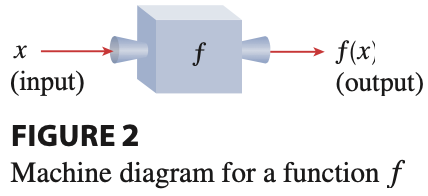
假設這個黑盒子或是工廠叫做 $f$ ,把 $x$ 丟進去,出來的東西稱為 $f(x)$ 。 在寫程式時會把 $x$ 稱為輸入 (input), $f(x)$ 稱為輸出 (output)。
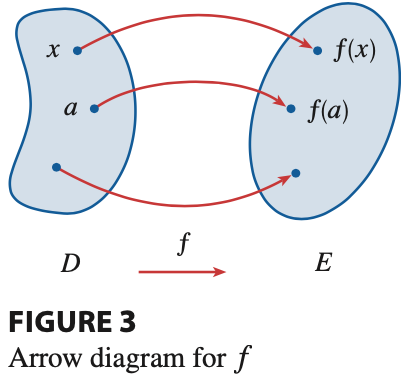
假設 $x$ 所處在的空間叫做 $D$ 我們會用英文 domain 來稱呼這個空間, $f(x)$ 可以待的空間叫做 $E$ ,我們會用 range 來稱呼這個空間。
1.1 Four Ways to Represent a Function
這一章節我們會教表示函數的四種方法,
- 用文字描述 (words)
- 用公式表示 (formula)
- 用表格表達 (table of values)
- 用圖展示 (graph)
下面會給 $A, B, C, D$ 四個例子,例子 $A, C$ 用了文字描述與公式描述函數, $B$ 用了表格表達函數, $D$ 用圖展示函數。
Example 1.1.A (圓面積函數)
一個圓的面積可以視為一個函數 $A(r)$,變數為圓的半徑 $r$ 。 $$ A(r) = \pi r^2 $$ 在英文我們會這麼說 $A$ is a function of $r$ , 我們會用獨立變量(independent variable)來叫 $r$ ,因為他不會受到任何限制, 我們可以用 dependent variable 來指函數 $A$ ,因為面積的數值是受到半徑控制, 一般來說你在數學系的課才可以看到這麼漂亮的函數,有關實際的應用通常不會有這麼漂亮的函數解。
Example 1.1.B (世界人口函數)
我們也可以把世界人口 $P(t)$ 看成一個函數,變數為時間 $t$ ,描述一個函數的第二個方法就是用表格, 你可以發現一般來說,我們可以把我們感興趣的問題寫成一個函數,但是通常就不是很漂亮的函數,但是我們可以用簡單的函數去做逼近與預測, 下表就是用西元的年份去描述當時的人口統計
| 年份 | 世界人口統計 (單位:千萬) |
|---|---|
| 1900 | 165 |
| 1910 | 175 |
| 1920 | 186 |
| 1930 | 207 |
| 1940 | 230 |
| 1950 | 256 |
| 1960 | 304 |
| 1970 | 371 |
| 1980 | 445 |
| 1990 | 528 |
| 2000 | 608 |
| 2010 | 687 |
我們可以這麼說 $P$ is a function of $t$ 。
Example 1.1.C (花費函數)
大家有去寄過信嗎?還是都寄 email 了,或是大家有去坐跳錶的計程車不是uber那種你輸入上車地點下車地點就跟你說價格的那種, 信封花費
The cost C of mailing an envelope depends on its weight w. Although there is no simple formula that connects w and C, the post office has a rule for determining C when w is known.
Example 1.1.D
垂直加速度
The vertical acceleration a of the ground as measured by a seismograph during an earthquake is a function of the elapsed time t. Figure 1 shows a graph generated by seismic activity during the Northridge earthquake that shook Los Angeles in 1994. For a given value of t, the graph provides a corresponding value of a.
1.2 Mathematical Models: A Catalog of Essential Functions
在現實的世界,我們可以不思考的活著,不思考的活著表示只要考慮基本生理需求:食物、水、空氣和睡覺。 當我們想要進一步理解這個世界就需要建立連結,人類區別於其他動物有一點是,人類特別會注意到事物的關聯, 在短時間注意到關聯一般的動物也可以做到, 例如狗的制約實驗,我們每次搖鈴然後餵狗吃飯,久了以後只要搖鈴狗就會流口水,這表示狗已經把搖鈴跟食物兩件事連結在一起, 對於動物時間再拉長一點就不行了(朝三暮四), 但是人特別可以把長時間的關聯性連結起來,所以人類發展出農業,要去更好的預測事物的發展,人類發展出一套數學建模流程。 對於再長的時間人類也會像猴子一樣朝三暮四,無法建立連結,像是皇帝會吃仙丹要短期的精神奕奕放棄長期的健康,有些人會求佛要立即的錢財放棄長遠的富貴。
數學建模的流程圖

- 我們會先對於現實的某項事件感興趣,想要預測或是更好的解釋。
- 下一步我們會想建立數學模型。
- 然後我們可以得到數學模型的結論。
- 看完理論上的結論,我們可以拿來預測真實世界。
如果效果不好,我們可以重複這個步驟,直到我們得到比較好的模型。
Linear
Polynomials
Power Functions
Integrals
這一章主要是教積分的定義,跟微積分基本定理。
Exercise
4.1
2, 4, 15, 16, 20, 24
4.2
23, 25, 32, 42, 52, 58, 59, 77, 83
4.3
9, 10, 21, 22, 25, 30, 59, 67, 84, 85
4.4
5, 7, 23, 24, 29, 31, 61, 62, 63, 64, 75, 77
4.5
2, 4, 10, 12, 15, 16, 37, 39, 44, 45, 59, 67, 68, 75, 80
The Area and Distance Problems
這一章要教的是積分,在以前有計算面積的需求,大家使用各種其思妙想去解決各自面對的問題,但是微積分給出一般性的解法。
Example 1
以 \[y = x^2\] 為範例看 \[0 <= x <= 1\] , 曲面下的面積。
這邊以這實際的例子去講解,怎麼去求面積,左邊點,右邊點,中間點
The Definite Integral
這邊要教積分的定義,這個定義是黎曼積分
The Fundamental Theorem of Calculus
微積分基本定理
Indefinite Integrals and the Net Change Theorem
這一節給出許多積分的性質
The Substitution Rule
積分替換法,幫助大家可以會積更多函數