星際彗星 3I/ATLAS 竟是「半重水」時間膠囊!
Interstellar Comet is a Time Capsule From Another Star System
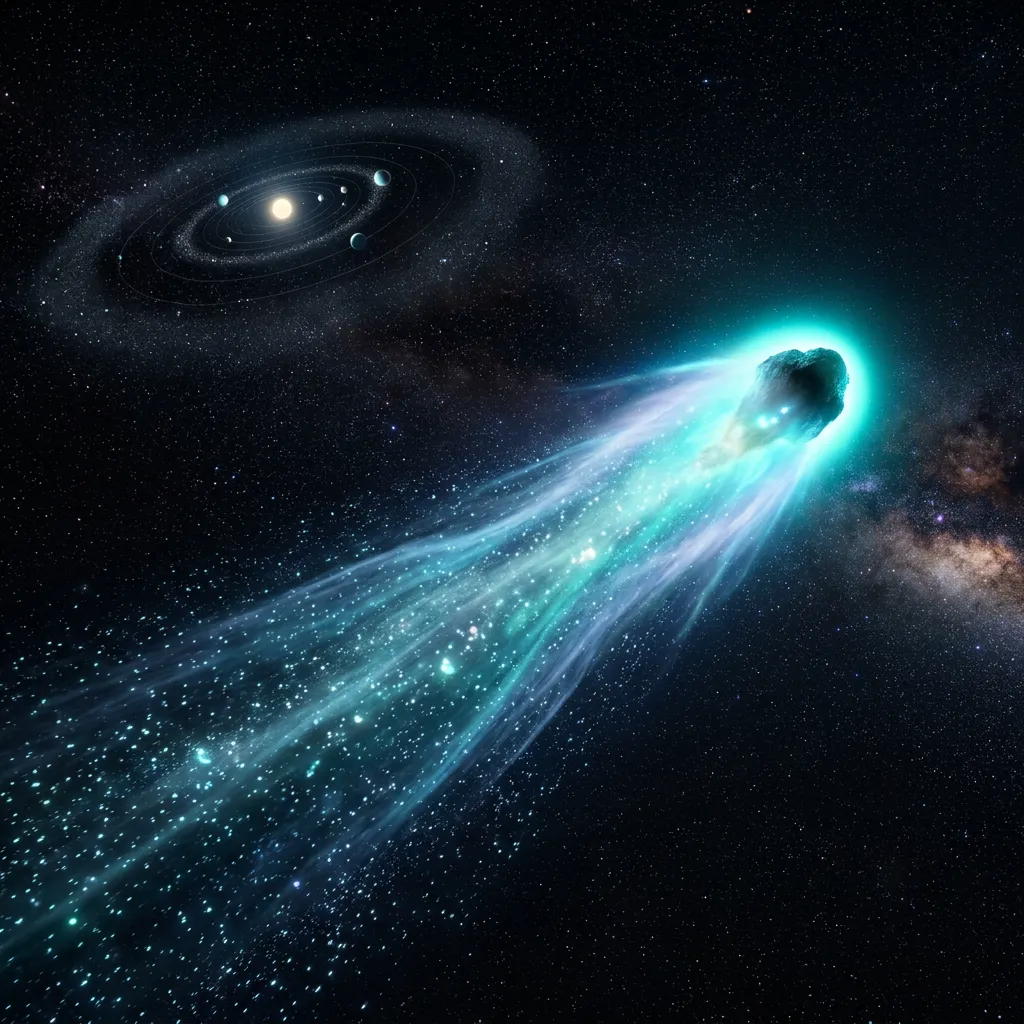
天文學家利用電波望遠鏡對一顆星際彗星進行了深入觀測,獲取了關於這個天體何時以及在何處形成的新線索。
Astronomers using radio telescope observations to get an inside look at an interstellar comet have gleaned new insights into when and where the celestial object formed.
這顆名為 3I/ATLAS 的彗星於去年七月首次被研究人員發現飛越我們的太陽系,隨即引發了全球關注。它是人類在我們這個宇宙角落裡觀測到的僅僅第三個「星際天體」——即起源於我們太陽系之外的天體。這顆彗星於去年十二月開始啟程離開太陽系。
The comet, named 3I/ATLAS, gained global attention when researchers first discovered it zipping through our solar system in July. It’s only the third interstellar object, or celestial body that originated outside our solar system, to be spotted passing through our corner of the universe. The comet began its exit of our solar system in December.
根據研究作者指出,這項針對彗星成分的初步研究於 4 月 23 日發表在《自然·天文學》(Nature Astronomy)期刊上,顯示其起源地與我們的太陽系有著天壤之別。
Initial research about the comet’s composition, published April 23 in the journal Nature Astronomy, shows that it originated somewhere very different from our own solar system, according to the study authors.
這些觀測是在去年十一月初、即這顆彗星最接近太陽的幾天後,利用位於智利的「阿塔卡瑪大型毫米及次毫米波陣列」(ALMA)進行的。
The observations were made using the Atacama Large Millimeter/submillimeter Array, or ALMA, in Chile in early November, just days after the comet passed closest to our sun.
ALMA 電波望遠鏡使研究人員能夠測量彗星內部的「氘」(Deuterium),這標誌著科學家首次在星際天體中偵測到這種氫的同位素。
The ALMA radio telescope enabled researchers to measure deuterium within the comet, marking the first time this isotope of hydrogen has been detected in an interstellar object.
💧 什麼是半重水?極致冰冷的化學烙印
What is Semi-Heavy Water? The Chemistry of Extreme Cold
🔬 氫同位素與 HDO:比一般水更重的秘密
Chemistry 101普通的水(H₂O)通常由兩個氫原子和一個氧原子組成,其中的氫原子僅包含一個質子(一種帶正電的亞原子粒子)。而「氘化水」(deuterated water, HDO)——也被稱為「半重水」——則略有不同,其中的氫原子額外包含了一個中子(不帶電的亞原子粒子)。中子的加入使得氘化水比普通水更重。
Water, or H2O, typically contains two hydrogen atoms and one oxygen atom. The hydrogen atoms include a single proton, or a positively charged subatomic particle. Deuterated water differs slightly in that the hydrogen atoms each also contain a single neutron, or a subatomic particle with no charge. The addition of the neutron means that deuterated water is heavier than H2O.
「氘通常存在於太陽系彗星的水和地球海洋中,形式為氘化水(HDO),亦稱半重水,」研究的主要作者、密西根大學天文學系博士候選人路易斯·愛德華多·薩拉薩爾·曼薩諾(Luis Eduardo Salazar Manzano)在一封電子郵件中寫道。
“Deuterium is generally found in the water of Solar System comets and in Earth’s oceans in the form of deuterated water, HDO, also called semi-heavy water,” lead study author Luis Eduardo Salazar Manzano, a doctoral candidate in the department of astronomy at the University of Michigan, wrote in an email.
「我們利用 ALMA 的觀測表明,3I/ATLAS 水中的氘豐度是地球海洋的 40 倍以上,同時也是太陽系彗星的 30 倍以上。」曼薩諾說。
“Our observations with ALMA indicate that the abundance of deuterium in the water of 3I/ATLAS is more than 40 times the value in Earth’s oceans and more than 30 times the value in Solar System comets.”
❄️ 窺探銀河系的遠古面貌
A Peek Into the Milky Way's Deep Past
這些發現可能讓研究人員更好地理解這顆彗星所屬恆星系統的極端環境,甚至能洞察我們太陽系誕生前很久遠的銀河系樣貌。
The findings may allow researchers to better understand the extreme conditions of the comet’s planetary system — and even discern what the Milky Way galaxy was like long before our solar system appeared.
「星際天體是『時間膠囊』,將來自其他行星系統形成環境的物質帶到我們面前,而我們的測量終於讓我們得以打開這些時間膠囊,一窺這些天體起源處的物理條件,」曼薩諾說。
“Interstellar objects are time capsules that bring material from the environments where other planetary systems formed, and our measurements are finally allowing us to open those time capsules and peek at the physical conditions where these objects originated,” Salazar Manzano said.
研究人員表示,研究 3I/ATLAS 中氘化水的豐度可以揭示這顆彗星在何處形成的特徵烙印。
Studying the abundance of deuterated water within 3I/ATLAS can reveal signatures of where the comet formed, the researchers said.
「氘的富集通常發生在星際空間的寒冷分子雲中形成水之時,這通常與圍繞其他恆星的行星系統形成的時間大致相同,」曼薩諾解釋道。
“The enrichment in deuterium generally happens when water forms in cold molecular clouds in interstellar space, which is generally around the same time that solar systems around other stars form,” Salazar Manzano said.
他指出,研究人員相信這顆星際彗星起源的行星系統異常寒冷,遠比我們太陽系形成時要冷得多。
Researchers believe that the planetary system where the interstellar comet originated was incredibly cold, much colder than our own solar system during its formation, he said.
「3I/ATLAS 形成環境的溫度低於 30 克耳文(Kelvin),相當於攝氏零下 243.14 度(華氏零下 405.67 度),」他說。
“The temperature in the formation environment of 3I/ATLAS was less than 30 Kelvin, which corresponds to -243.14 Celsius, or -405.67 Fahrenheit,” he said.
🌌 追溯 110 億年的宇宙歷史
Tracing 11 Billion Years of Cosmic History
先前的研究表明,這顆星際彗星的年齡可能高達 110 億年,遠比形成於 45 億年前的我們的太陽系和太陽要古老得多。
Earlier research has indicated that the interstellar comet could be up to 11 billion years old, much older than our solar system or sun, which formed 4.5 billion years ago.
曼薩諾表示,儘管困在彗星內部的冰水可能在宿主恆星誕生前很久就已形成,但 3I/ATLAS 本身是在其後誕生的,起源於圍繞該恆星旋轉的氣體與塵埃原行星盤——這也是行星形成的同一個盤面。
The water still trapped within the comet likely formed long before its host star, but 3I/ATLAS was born afterward from a protoplanetary disk of gas and dust that swirled around the star — the same disk where planets form, Salazar Manzano said.
鑑於較高的溫度會因化學反應而降低氘的含量,研究人員認為 3I/ATLAS 形成並在原行星盤的外圍區域度過了它的大部分時間,從而完整保存了其驚人的氘化水豐度。
Given that hotter temperatures can reduce the amount of deuterium due to chemical reactions, the researchers believe that 3I/ATLAS formed and spent most of its time on the outer reaches of the protoplanetary disk, preserving its deuterated water abundance.
這些新發現與先前的觀測結果不謀而合,先前的研究發現該星際彗星內部含有極其豐富的二氧化碳,這同樣與在原行星盤外側形成的天體特徵完全吻合。
The new findings agree with previous observations that found a high abundance of carbon dioxide within the interstellar comet, also consistent with an object that formed in the outer part of a protoplanetary disk.
📡 為什麼使用 ALMA?電波天文學的獨特優勢
Why ALMA? The Unique Power of Radio Astronomy
利用 ALMA 望遠鏡進行觀測是至關重要的,因為這台電波望遠鏡能夠以比傳統望遠鏡更接近太陽的角度進行觀測。電波望遠鏡探測的是低能量的電波,而不是高能量的可見光或熱能,後者可能會損壞傳統光學望遠鏡(如詹姆斯·韋伯太空望遠鏡)的光學精密組件。
Using ALMA for observations was key because the radio telescope can point at a closer angle to the sun than traditional telescopes. Radio telescopes detect low-energy radio waves, rather than high-energy visible light or heat that can destroy the optical components of telescopes such as the James Webb Space Telescope.
研究團隊在彗星飛至距離太陽 1.26 億英里(2.03 億公里)以內不久後使用 ALMA 展開研究——此時的距離已足夠讓彗星內部的冰在太陽的熱量作用下「昇華」為可探測的氣體。
The team used ALMA to study the comet shortly after it came within 126 million miles of the sun (203 million kilometers)— close enough for the comet’s ice to sublimate as a detectable gas due to the sun’s heat.
研究人員原本預期會觀測到普通的 H₂O,但在 3I/ATLAS 中卻未能偵測到它。
The researchers were expecting to spot H2O, but it was undetected in 3I/ATLAS.
「這並不代表 3I/ATLAS 沒有普通的水,這只是意味著它低於我們觀測的靈敏度極限,」曼薩諾說。「然而,當我們意識到即使在沒有偵測到普通水的情況下,我們卻成功偵測到了氘化水時,我們感到無比震驚!這立即告訴我們,3I/ATLAS 是一個真正不同尋常的奇特天體。」
“This does not mean that 3I/ATLAS did not have ordinary water; it only means that it was below the sensitivity of our observations,” Salazar Manzano said. “However, we got a really big surprise when we realized that we had detected deuterated water despite our non-detection of ordinary water, which told us immediately that 3I/ATLAS was a truly unusual object.”
🔭 冰山一角:未來發現的展望
The Tip of the Iceberg: Future Cosmic Prospects
天文學家不太可能確定 3I/ATLAS 究竟來自哪個具體的行星系統,但這並不意味著這個天體無法提供寶貴的線索;星際天體可以揭示我們宇宙中原本隱藏且不為人知的奧秘。
It’s unlikely that astronomers will be able to determine which planetary system 3I/ATLAS came from, but that doesn’t mean the celestial body won’t provide invaluable insights; interstellar objects can reveal otherwise hidden and unknown aspects about our universe.
位於智利的維拉·魯賓天文台(Vera C. Rubin Observatory)於去年六月發布了首批圖像,預計將以更高的頻率發現更多星際天體——這可以使曼薩諾和他的同事們得以判斷,3I/ATLAS 在其氘化水豐度上究竟是一個罕見的「異類」,還是其他類似的星際彗星也含有類似的富集特徵。
The Vera C. Rubin Observatory, located in Chile, released its first images in June and is expected to spot interstellar objects with more frequency — which could enable Salazar Manzano and his colleagues to determine if 3I/ATLAS is an outlier with its deuterated water abundance, or if other such comets contain similar enrichment.
「在研究這些星際彗星方面,我們顯然只看到了冰山一角,」並未參與此項研究的行星天文學家西奧多·卡雷塔博士(Dr. Theodore Kareta)說。他是費城附近維拉諾瓦大學天體物理與行星科學助理教授。「隨著我們學會提出新的問題,並從令人困惑的答案中理出頭緒,我們科學界的研究思路正在迅速演變。」
“We’re very clearly only seeing the top of the iceberg when it comes to studying these interstellar comets,” said planetary astronomer Dr. Theodore Kareta, an assistant professor of astrophysics and planetary science at Villanova University near Philadelphia. “Our thinking as a community is evolving rapidly as we learn to ask new questions and make sense of confusing answers.”
卡雷塔表示,彗星中氘的存在就像是「指紋」,展示了這顆彗星與生俱來的本質成分——同時也展示了我們銀河系在 100 多億年前(當時重金屬元素的含量遠低於現在)是什麼樣子。
Kareta has studied 3I/ATLAS, but he was not involved in this research. The presence of deuterium in the comet is analogous to fingerprints, he said, showing what the comet was essentially born with — as well as what our galaxy was like more than 10 billon years ago when it was less enriched with metals than it is now.
「隨著我們的銀河系日漸衰老,它隨時間建立起來的彗星種類也發生了變化,這意味著它能製造的行星種類也隨之改變,」卡雷塔在一封電子郵件中寫道。「這正是這些星際彗星如此令人著迷的地方——不一定在於它們是什麼或它們長什麼樣,而是在於它們能讓我們回溯時光,去查明『外面的行星』是否和我們家園的行星一樣。」
“As our galaxy has gotten older, the kinds of comets it has built over time has changed, and that means that the kinds of planets it can make have changed too,” Kareta wrote in an email. “This is what makes these interstellar comets so interesting — it’s not necessarily what they are or what they look like, but in how they let us look back in time to figure out if the planets ‘out there’ look like the ones we have at home.”